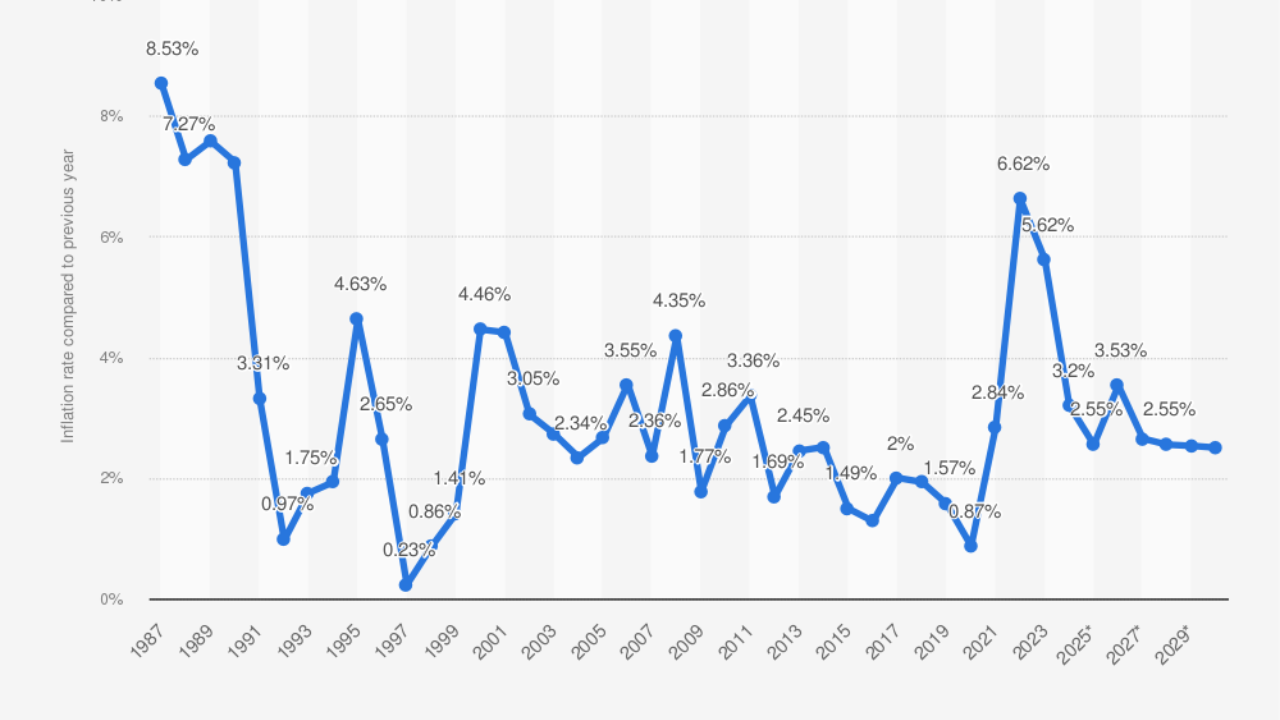
Australia’s inflationary pressures intensified again at the end of 2025, with the annual Consumer Price Index (CPI) climbing to 3.8% in December, up from November’s three-month low of 3.4%, according to data released by the Australian Bureau of Statistics (ABS).
The reading exceeded market expectations of 3.6% and remained firmly above the 2–3% target range set by the Reserve Bank of Australia (RBA), reinforcing concerns that inflation is proving stickier than policymakers had hoped.
Services Inflation Surges to Two-Year High
A key driver behind December’s inflation rebound was services inflation, which accelerated to 4.1% year-on-year, its highest level in two years, compared with 3.6% in the previous quarter.
The increase was largely attributed to year-end holiday travel and accommodation costs, a seasonal but increasingly expensive component of household spending. Elevated rents also continued to place upward pressure on services prices, reflecting Australia’s ongoing housing supply constraints and strong population growth.
Services inflation has become a central focus for the RBA, as it tends to reflect domestic demand conditions and wage pressures more directly than volatile goods prices.
Goods Inflation Edges Higher as Energy Costs Bite
While goods inflation remained more contained than services, it still ticked up to 3.4% from 3.3%, driven mainly by a sharp acceleration in electricity prices.
Electricity costs surged 21.5% year-on-year, compared with 19.7% previously, as several state-level energy rebates expired toward the end of 2025. The rollback of temporary government support measures has begun to expose households more fully to underlying energy price pressures.
Price Pressures Remain Broad-Based
Beyond energy and travel, inflationary pressures were widespread across the CPI basket, indicating that price increases are not confined to a few volatile categories:
- Food and non-alcoholic beverages: rose 3.4%, up slightly from 3.3%, reflecting higher production and distribution costs.
- Alcohol and tobacco: increased 4.9%, accelerating from 4.3%, largely due to excise duties and input costs.
- Clothing and footwear: grew 3.4%, easing from a steep 5.1% previously but still elevated.
- Furnishings and household equipment: climbed 2.0%, up from 1.3%, pointing to renewed demand pressures.
- Health: remained steady at 3.6%, driven by medical services and insurance costs.
- Transport: slowed to 1.6% from 2.7%, helped by softer fuel prices.
- Communication: eased marginally to 1.1%.
- Recreation and culture: jumped to 4.4%, up sharply from 3.0%, reflecting discretionary spending during the holiday season.
- Education: remained elevated at 5.4%, unchanged from the previous reading.
- Insurance and financial services: held steady at 2.5%.
The persistence of price increases across essential and discretionary categories suggests inflationary momentum remains embedded in the economy.
Underlying Inflation Still Elevated
Australia’s trimmed mean CPI, the RBA’s preferred measure of underlying inflation, inched up to 3.3% year-on-year from 3.2%, in line with market estimates.
Although the increase was modest, it underscored the difficulty of returning inflation to target without maintaining restrictive monetary conditions for longer.
On a monthly basis, CPI rose 1.0% in December, rebounding from a flat reading in November. The monthly jump highlights the volatility of price dynamics and the influence of seasonal spending patterns.
Implications for Monetary Policy
The stronger-than-expected inflation print complicates the policy outlook for the RBA. While economic growth has shown signs of moderation, inflation remains uncomfortably high, particularly in services, which are closely linked to domestic demand and labour market conditions.
Financial markets had been cautiously pricing in the possibility of rate cuts later in 2026. However, December’s data may force policymakers to delay any easing, especially if upcoming inflation readings fail to show sustained progress toward the target range.
Market Reaction and Outlook
The inflation surprise has already influenced financial markets, with Australian bond yields fluctuating, the Australian dollar hovering near multi-year highs, and equities reacting cautiously to the prospect of prolonged tight monetary policy.
Looking ahead, attention will turn to January and February 2026 inflation data, as well as wage growth and employment figures, for clearer signals on whether price pressures are easing or becoming further entrenched.
For now, Australia’s inflation story remains one of resilience rather than retreat, keeping the RBA firmly on guard.